Hello, I’m Choi, a Seoul-based travel influencer who shares firsthand experiences of local food, markets, museums, and neighborhoods across Korea.
If you are looking for Dongdaemun Market food, dakhanmari may be one of the first dishes you encounter. Dongdaemun is also known for shopping and late-night fashion malls, but its narrow market streets are filled with Korean restaurants serving much more than chicken hot pot.
Since I was visiting alone for lunch, I stopped at Sunheene Bindaetteok Dakhanmari Dongdaemun Main Branch and ordered yukhoe bibimbap, meat bindaetteok, and sikhye. These dishes were easier to order as a solo diner and offered a generous introduction to traditional Korean food.
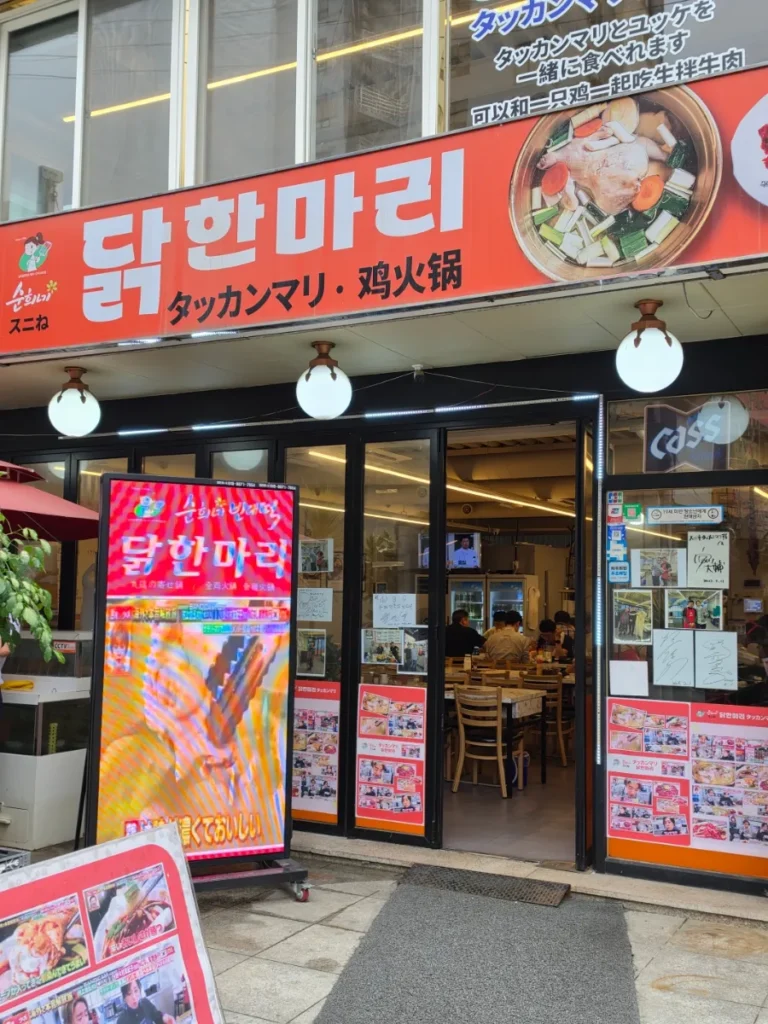
How to Find This Korean Restaurant Near Dongdaemun Market
The restaurant is located in a busy market area filled with clothing stores, small restaurants, and narrow alleys.
I followed the route shown on Naver Map, but the path appeared to end before I reached the restaurant. If the same thing happens to you, turn left where the road ends. The restaurant is around the corner.
Following the map too literally may leave you wondering whether you have taken the wrong turn. Look for the large red sign with the Korean word 닭한마리, meaning “one whole chicken.”
Quick Guide
- Restaurant: Sunheene Bindaetteok Dakhanmari Dongdaemun Main Branch
- Korean name: 순희네빈대떡 닭한마리 동대문본점
- Address: 1F–2F, 20 Jong-ro 40ga-gil, Jongno-gu, Seoul
- Korean address: 서울특별시 종로구 종로40가길 20 1, 2층
- Area: Dongdaemun Market
- Good for: Korean food, solo lunch, bindaetteok and yukhoe bibimbap
📍 View Sunheene Bindaetteok Dakhanmari on Google Maps
Opening hours and menu prices may change, so check the latest information before visiting.
A Korean Restaurant for Solo Dining in Dongdaemun
When I eat alone, I usually visit shortly before the main lunch period or after the busiest dining time. This makes it easier to find a table, although arriving too late can mean running into a restaurant’s afternoon break.
I arrived shortly after 1 p.m. Other customers were already eating dakhanmari, and the smell immediately made me want to order it too. However, dakhanmari is cooked in a large pot at the table and is better suited to two or more diners.
Fortunately, the menu also includes dishes that are easier to order alone, such as yukhoe bibimbap and bindaetteok.
The menu included Korean, Japanese, Chinese, and English descriptions. Dongdaemun attracts many international visitors, so having a multilingual menu makes ordering easier if you do not speak Korean.
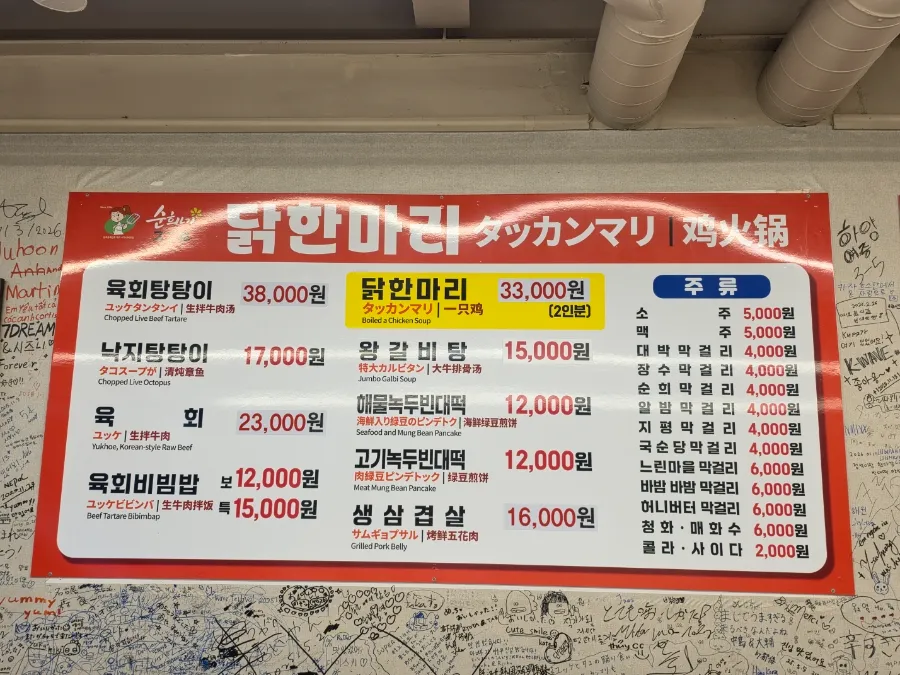
Dongdaemun Market Food I Ordered for Lunch
I ordered three items:
- Regular yukhoe bibimbap: KRW 12,000
- Meat bindaetteok: KRW 12,000
- Sikhye: KRW 2,000
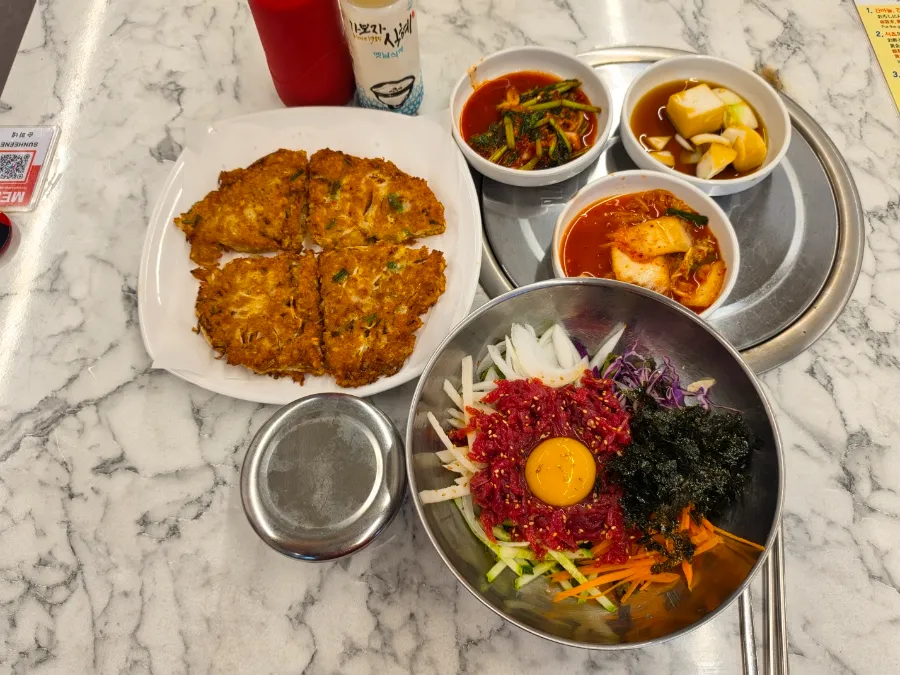
When everything arrived, it was a larger meal than I would normally order for myself. Still, ordering both the bibimbap and bindaetteok gave me the chance to try two very different types of traditional Korean food.
What Is Yukhoe Bibimbap, Korean Raw Beef Rice?
Yukhoe bibimbap (육회비빔밥) is a bowl of rice, vegetables, seaweed, and seasoned raw beef mixed together before eating.
The word yukhoe refers to Korean-style raw beef. Thin strips of fresh beef are usually seasoned lightly with ingredients such as sesame oil, salt, sugar, garlic, or soy sauce. Preparation varies by restaurant.
Unlike steak tartare, Korean yukhoe is commonly cut into thin strips rather than finely minced. It is often served with sliced Korean pear and a raw egg yolk. In yukhoe bibimbap, the beef is combined with rice and vegetables to make a complete meal.
My bowl came with plenty of raw beef, cucumber, carrots, onions, cabbage, seaweed, and an egg yolk in the center. The regular size contained more meat than I expected.
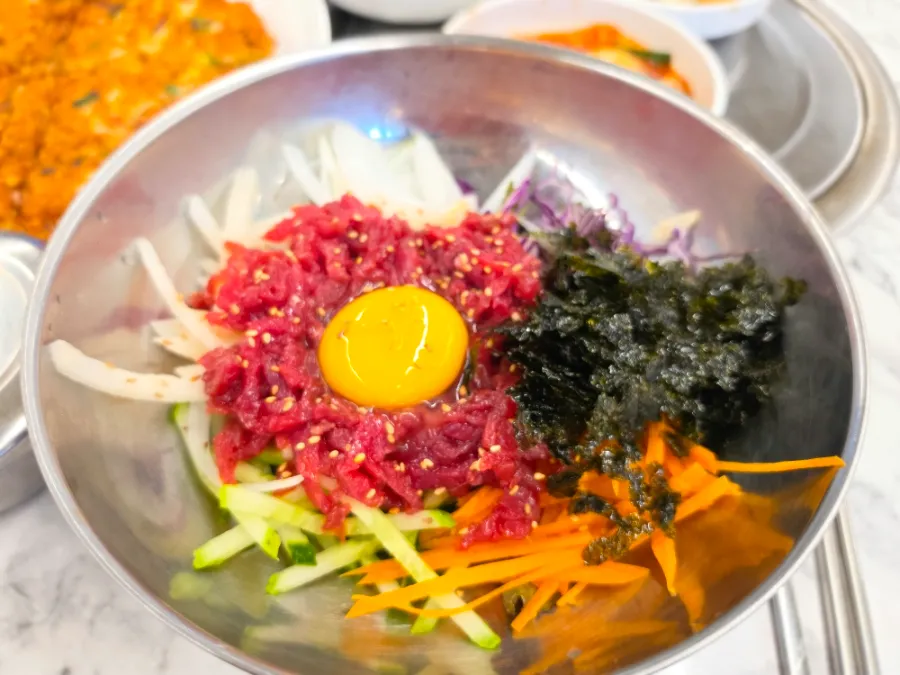
I added only about half of the rice and mixed everything together. Using less rice allowed me to taste the beef and vegetables more clearly.
I began orthodontic treatment in my mid-forties, so I currently avoid food that is particularly hard or chewy. The raw beef was soft enough for me to eat comfortably, and I liked the generous amount of vegetables.
Travelers should remember that yukhoe contains raw beef and usually a raw egg yolk. If you are pregnant, immunocompromised, or uncomfortable eating raw animal products, choosing a fully cooked dish would be safer.
What Is Bindaetteok, a Korean Mung Bean Pancake?
Bindaetteok (빈대떡) is a savory Korean pancake traditionally made from ground mung beans. It is different from the thin pancakes eaten for breakfast in many Western countries.
The mung-bean batter may be mixed with ingredients such as mung bean sprouts, green onions, kimchi, pork, or other vegetables. The pancake is then fried on a hot griddle until the outside becomes crisp and golden while the inside remains softer and filling.
Bindaetteok is closely associated with traditional Korean markets. It is also commonly paired with makgeolli, a cloudy Korean rice wine, especially on rainy days.
I ordered the meat bindaetteok, called gogi nokdu bindaetteok on the menu. It arrived already cut into pieces, making it easy to share—or, in my case, to eat alone.
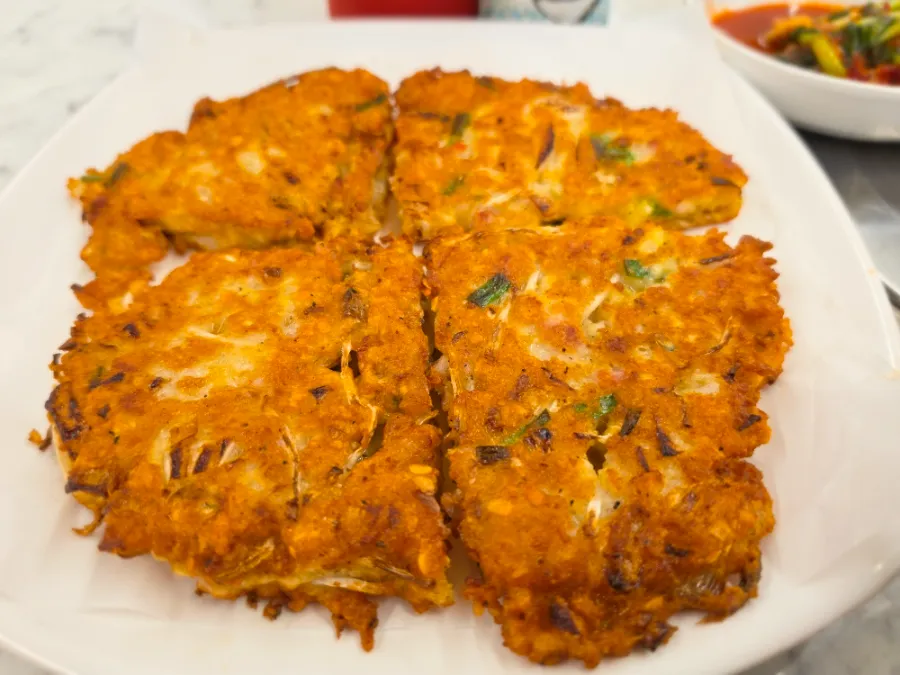
I genuinely love bindaetteok. While traveling in Vietnam, I ate bánh xèo about once a week and often thought about Korean mung bean pancakes. The two dishes use different batters and ingredients, but both offer the satisfying contrast of a crisp exterior and savory filling.
The restaurant served the bindaetteok with a soy-based dipping sauce containing pickled onions. My favorite way to eat it was to dip one piece in the sauce and place a slice of onion on top.
Because the pancake was quite substantial, ordering both bindaetteok and bibimbap was a lot for one person. Solo diners with a smaller appetite may want to choose just one main dish.
Banchan: Korean Side Dishes
The meal included several types of banchan, the small side dishes served with Korean meals.
My side dishes included napa cabbage kimchi, green onion kimchi, and pickled onions. The acidity and spice helped balance the richness of the fried pancake.
The restaurant also had a self-service area with additional kimchi. I had enough food on my table, so I did not take more.
Banchan selections can vary, so the side dishes served during your visit may be different.
Sikhye Instead of Makgeolli
Since it was raining, bindaetteok and makgeolli would have been a classic Korean combination. I still had work to do that afternoon, however, so I chose sikhye instead.
Sikhye (식혜) is a traditional sweet Korean rice drink made with malted barley and cooked rice. It is usually served cold and may contain a few grains of rice at the bottom.
The flavor is gently sweet, although the sweetness varies by brand and recipe. It does not taste creamy like milk or sharp like fruit juice. Instead, it has a light malt flavor that works well after salty or fried food.
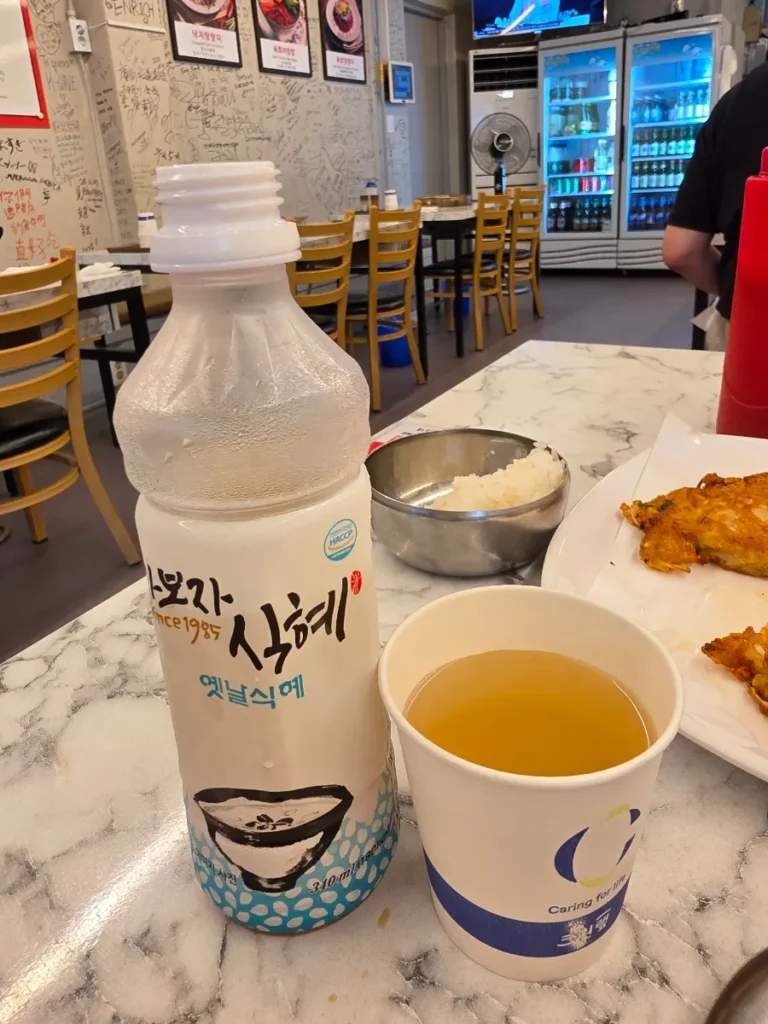
The sikhye cost KRW 2,000 and was not excessively sweet. I liked that a restaurant frequently visited by international travelers offered a traditional Korean drink alongside ordinary soft drinks.
Sikhye is nonalcoholic, making it a useful alternative if you want the Korean market-food experience without drinking makgeolli.
Ask About Soup If You Want a Warm Broth
Halfway through my bibimbap, I wanted something warm to drink with the rice. I asked whether soup was available, and a member of staff brought me a bowl of sogogi muguk.
Sogogi muguk (소고기뭇국) is a mild Korean soup made with beef and white radish. The radish softens as it cooks, while the beef gives the clear broth a savory flavor. It is much less spicy than kimchi stew or many red Korean soups.
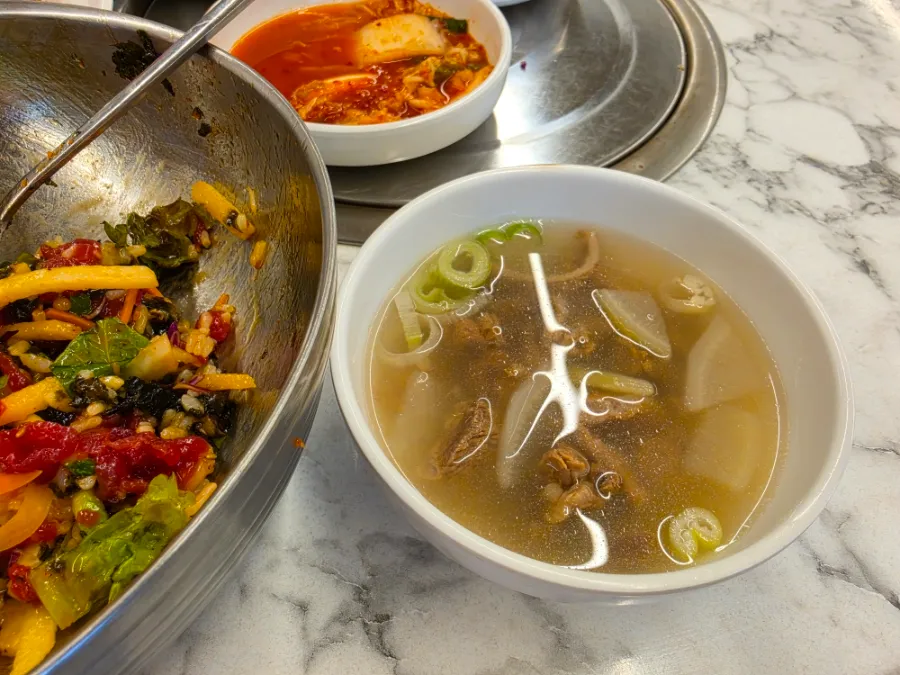
I am not certain whether the soup is normally included with the meal or was brought because I requested it. If your meal arrives without soup and you would like some, it is worth asking politely.
Is This Dongdaemun Market Restaurant Worth Visiting?
Sunheene Bindaetteok Dakhanmari is a practical option for travelers looking for Korean food near Dongdaemun Market, including those dining alone.
The restaurant’s name emphasizes dakhanmari, but the menu also includes several dishes that are easier to order alone. Yukhoe bibimbap works well as an individual meal, while bindaetteok is a good introduction to traditional Korean market food.
What I liked:
- Individual dishes were available for solo diners
- The menu included English explanations
- The regular yukhoe bibimbap contained plenty of beef and vegetables
- The bindaetteok was crisp and filling
- Traditional sikhye was available at a reasonable price
Things to consider:
- Yukhoe contains raw beef and egg yolk
- One bibimbap and one bindaetteok may be too much for a light eater
- The restaurant can be slightly confusing to find in the narrow market streets
- Dakhanmari is better suited to two or more people
If you are looking for Dongdaemun Market food beyond the usual street snacks, this restaurant offers a chance to try several recognizable Korean dishes in one place.
Next time, I would return with at least one other person and order the dakhanmari. For this solo lunch, however, the combination of yukhoe bibimbap and meat bindaetteok was more than enough.
Explore Seoul’s History on a Walking Tour
Dongdaemun and Jongno are surrounded by traditional markets, old city streets, palaces, and historic neighborhoods. If you want more context than you can get from walking around alone, a guided history tour can help explain how Seoul developed over time.
The Seoul History Walking Tour offered through Klook includes an English-speaking guide and visits historic areas in central Seoul. The exact route, duration, meeting point, and included attractions may vary by selected date, so check the current details before booking.
Book the Seoul History Walking Tour on Klook
Affiliate disclosure: This section contains an affiliate link. If you book through it, I may earn a small commission at no additional cost to you.
More Seoul Market Food Guides
Continue exploring Seoul with these firsthand food guides: