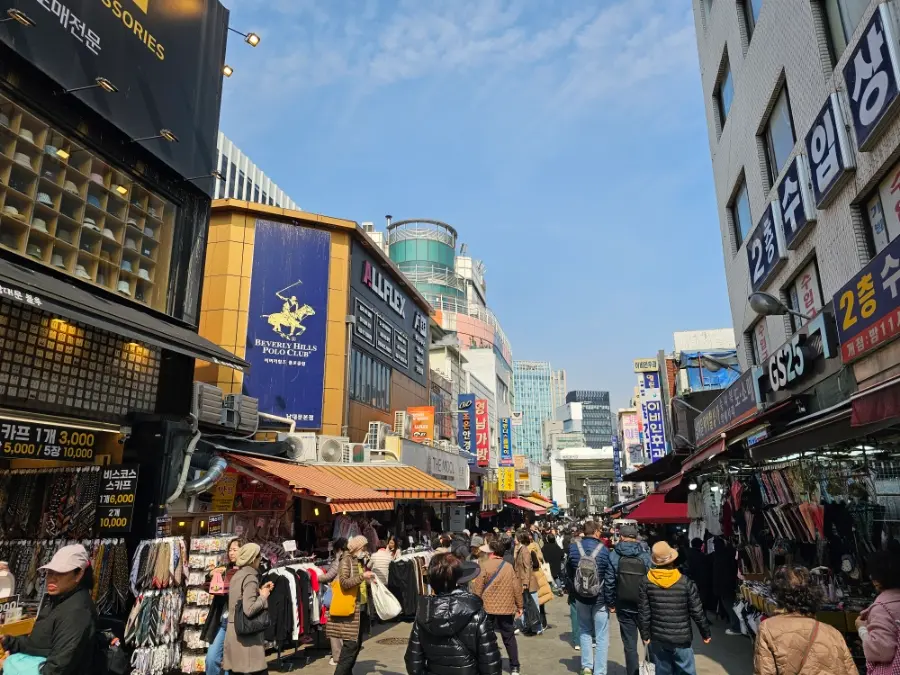
After spending 240 days traveling around Southeast Asia, I finally returned to Seoul.
Whenever I come back to Korea after a long trip, one of the first places I want to visit is Namdaemun Market Kalguksu Alley (남대문시장 칼국수골목).
It is not a stylish restaurant or a trendy Seoul food spot. Instead, it is a narrow alley filled with small food stalls, steaming bowls of noodles, and the generous portions that traditional Korean markets are known for.
I have been eating here since my twenties. Nearly 20 years later, I still return whenever I crave a simple and comforting Korean meal.
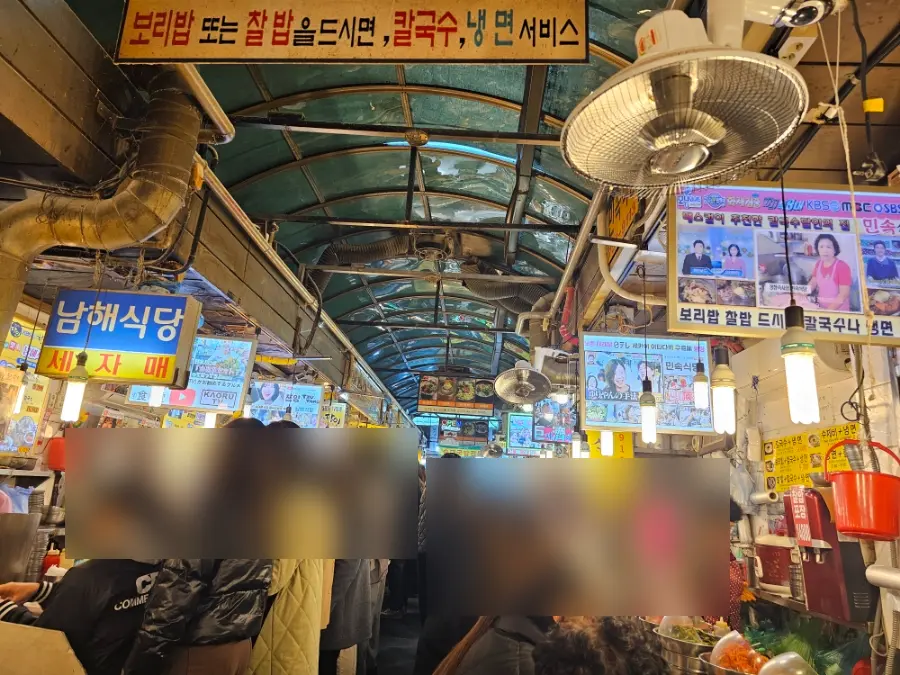
A Busy Monday at Namdaemun Market
I visited Namdaemun Market on a Monday. Although it was a weekday, the market was already crowded with shoppers and local diners.
I usually arrive at around 11 a.m., before the main lunch rush. On this visit, however, I slept late and reached the market after noon.
Several stalls were already full, and some customers were waiting for seats at their favorite restaurants.
Namdaemun Market Kalguksu Alley (남대문시장 칼국수골목) is a narrow indoor passage lined with small food stalls. Customers sit close together at counters while the owners prepare noodles, rice, soup, and side dishes directly in front of them.
I do not have one particular stall that I always visit. I normally walk into the alley and choose whichever place has an available seat.
That is part of the experience. The stalls serve similar set meals, but the taste and quality may vary slightly from place to place.
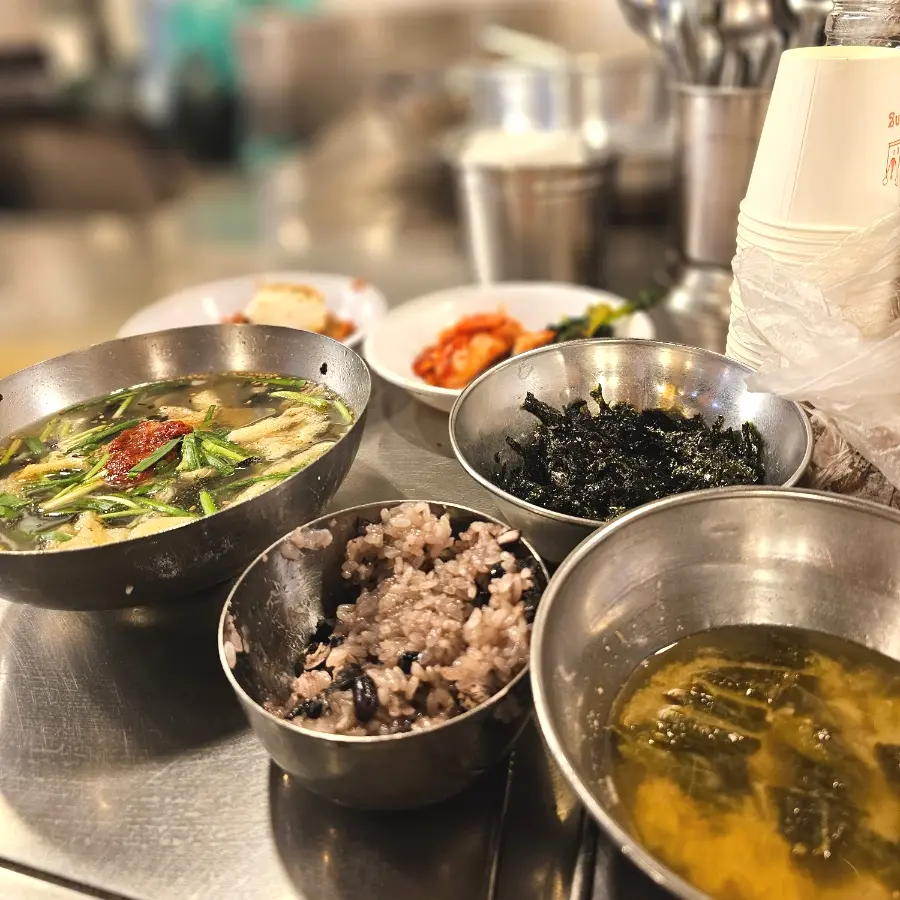
What I Ordered at Namdaemun Kalguksu Alley
I ordered the chalbap set (찰밥 세트), which cost 12,000 won at the time of my visit.
The set included:
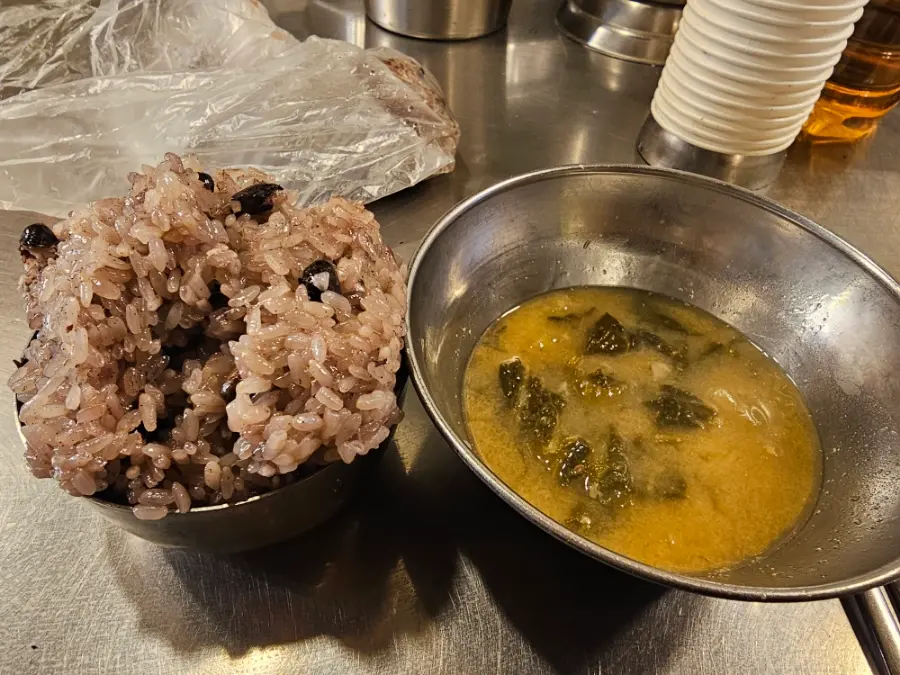
- Chewy mixed rice, chalbap (찰밥)
- Soybean paste soup with dried radish greens, siraegi doenjang-guk (시래기 된장국)
- Korean knife-cut noodle soup, kalguksu (칼국수)
- Spicy cold noodles, bibim naengmyeon (비빔냉면)
- Kimchi and simple Korean side dishes
- An extra bag of rice to take home
This generous combination is one reason Kalguksu Alley is popular with people looking for affordable Namdaemun Market food.
Instead of choosing only one dish, you can try several traditional Korean foods in a single meal.
Chewy Mixed Rice, Chalbap (찰밥)
Chalbap (찰밥) is a Korean mixed-rice dish with a chewier texture than ordinary steamed white rice. Depending on the recipe, it can be prepared with glutinous rice, barley, beans, or other grains.
The version I ate had a simple, nutty flavor and went well with kimchi and soybean paste soup. It was not an elaborate dish, but it felt filling and comforting—more like a home-cooked Korean meal than typical street food.
The owner also packed an extra portion of rice for me to take home. It did not taste quite as good once it had cooled, but it still made an easy dinner when wrapped in roasted seaweed.
Soybean Paste Soup, Doenjang-guk (된장국)
The rice was served with soybean paste soup, doenjang-guk (된장국).
The soup contained siraegi (시래기), which refers to dried radish greens. The greens become soft after simmering and absorb the savory flavor of the fermented soybean paste broth.
The warm, earthy soup paired especially well with the chewy rice. After spending months abroad, this simple combination reminded me of a Korean home-cooked meal.
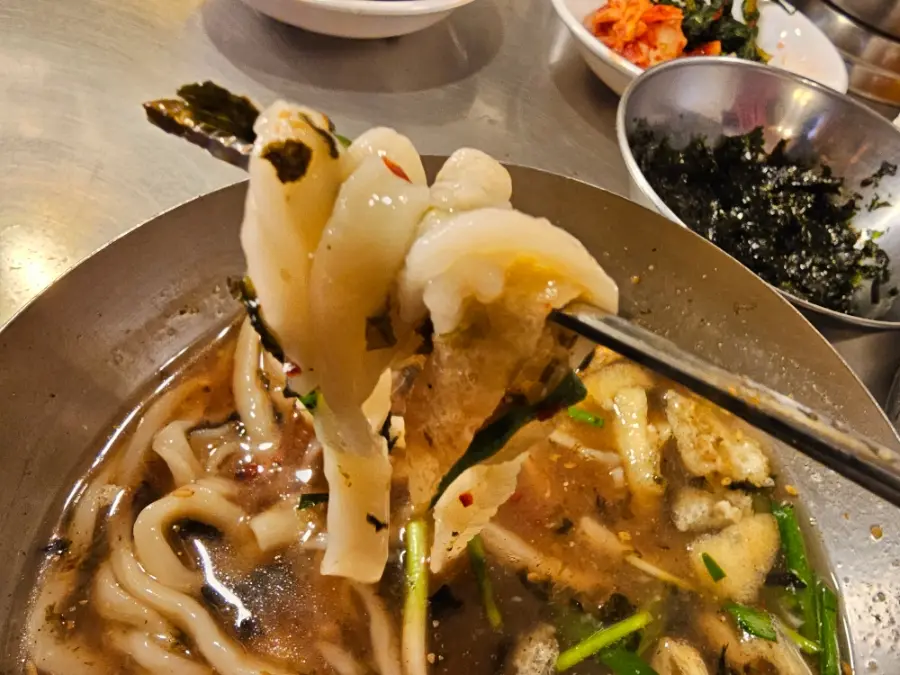
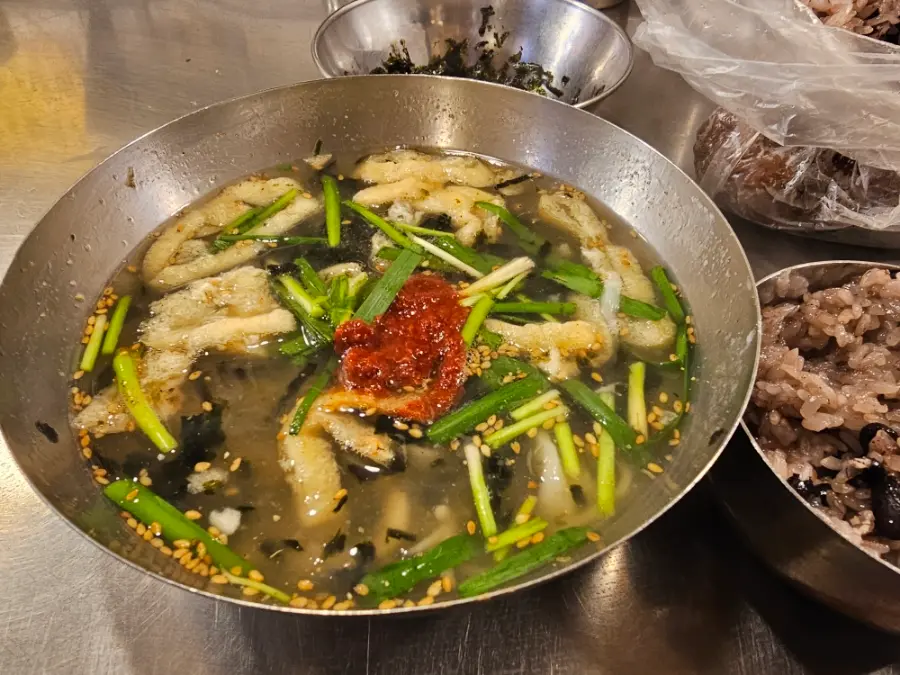
Korean Knife-Cut Noodles, Kalguksu (칼국수)
Kalguksu (칼국수) literally means “knife noodles” in Korean.
The noodles are made by rolling out wheat-flour dough and cutting it into strips with a knife. Unlike factory-made noodles, their width and thickness are not always uniform. This slightly uneven shape gives them a soft but pleasantly chewy texture.
Kalguksu is usually served in a warm, savory broth. Traditional versions are often made with dried anchovies, kelp, vegetables, or other simple ingredients.
To be honest, the kalguksu I ate on this particular visit was slightly disappointing.
The noodles were fine, but the broth lacked the deep, savory flavor I remembered from previous visits. At some stalls in this alley, I have enjoyed the broth so much that I finished every last drop. This one felt as if it were missing something.
Because I choose a different stall depending on where seats are available, the taste is not always exactly the same.
Kalguksu Alley is worth visiting for its atmosphere and variety, but that does not mean every bowl will be perfect.
Spicy Cold Noodles, Bibim Naengmyeon (비빔냉면)
The set also included a small bowl of spicy cold noodles, bibim naengmyeon (비빔냉면).
Unlike mul naengmyeon (물냉면), which is served in a cold broth, bibim naengmyeon is mixed with a red chili-based sauce. The sauce usually combines spicy, sweet, and tangy flavors.
The cold noodles provided a refreshing contrast to the warm kalguksu and earthy soybean paste soup.
This was not a full restaurant-sized bowl of naengmyeon. It was a small side portion included with the set. Still, it allowed me to enjoy both hot and cold noodles in one meal.
Serving several dishes together is one of the most interesting things about eating at Namdaemun Market Kalguksu Alley. Even when you order rice, the stall may also serve kalguksu, cold noodles, soup, and side dishes.
How to Find Namdaemun Market Kalguksu Alley
Address:
42-1 Namdaemunsijang 4-gil, Jung-gu, Seoul
서울특별시 중구 남대문시장4길 42-1
Nearest subway station:
Hoehyeon Station (회현역), Seoul Subway Line 4, Exit 5
📍 View Namdaemun Market Kalguksu Alley on Google Maps
After leaving Exit 5, walk toward Namdaemun Market for about one minute. The entrance to Kalguksu Alley is small and can be easy to miss.
Look for the Korean sign:
국수골목
It means “Noodle Alley.”
Opening hours and closing days vary by stall. Visiting in the morning or around lunchtime is usually the safest option, but the alley can become crowded during the main lunch period and on weekends.
Is Namdaemun Kalguksu Alley Worth Visiting?
Yes—especially if you want to experience a traditional Seoul market and eat alongside local shoppers.
The alley is narrow, crowded, and less polished than a modern restaurant. Seats are close together, and during the lunch rush you may feel some pressure to finish your meal quickly.
Travelers looking for a quiet or spacious dining experience may find it uncomfortable. However, that informal atmosphere is also what makes the alley memorable.
You can watch the food being prepared in front of you and try several traditional Korean dishes at an affordable price.
Every time I visit Namdaemun Market, I tell myself that I will try the famous braised cutlassfish, galchi-jorim (갈치조림), or find a new Korean set-meal restaurant.
Somehow, I always end up back in Kalguksu Alley.
Perhaps it is the generous portions, the comforting Korean flavors, or simply the memory of eating here for nearly 20 years.
Next time, I really should try the galchi-jorim.
More Seoul Market Food
Planning another traditional market visit in Seoul? Read my honest review of Tongin Market’s famous oil-fried rice cakes.